A sidewalk slab that sits higher than the one next to it has three possible fixes. You can grind the high edge down. You can lift the low slab up. Or you can tear it out and pour new. All three work, and each one is the wrong answer for somebody.
This is the guide to uneven sidewalk repair in the Quad Cities that we would give you standing on your walk. It covers what each method actually does, where it fails, how they compare on cost and downtime, and how to tell which one your slab needs. We have poured concrete here since 1979 and added a dedicated trip hazard grinding division in 2022, so we see all three outcomes regularly.
The short version: if the slabs are sound and the only problem is height, grind or lift. If the slab itself is broken, replace it. The rest of this article is the long version, because “sound” is where people get it wrong.
Why Do Sidewalk Slabs Become Uneven in the First Place?
Concrete does not move on its own. Something underneath it moves, and the slab goes along for the ride. Before you choose a fix, it helps to know which of these four is doing the pushing:
- Tree roots. The most common cause on residential streets. A maturing root lifts one slab while the neighbor stays put. The high slab is usually intact; it has just been jacked up from below
- Settlement and washout. Water running along the edge of the walk carries base material away, or the original fill was never compacted. One slab sinks. The low slab is the problem, not the high one
- Frost heave. Water in the soil freezes, expands, and lifts sections through the winter. Some of it relaxes in spring. Some of it does not
- Poor original installation. Thin slabs, no base, joints in the wrong place. These sidewalks tend to fail in several ways at once
Does the Cause Change the Fix?
Yes, and this is the part most quotes skip. If roots lifted a slab, grinding the edge solves today’s hazard, but the root keeps growing. If a slab settled because water is undermining it, lifting it back up without fixing the drainage just resets the clock. Matching the repair to the cause is the difference between fixing a sidewalk once and fixing it every three years. We will tell you which one you have, because it changes our recommendation.
How Much Height Difference Counts as a Trip Hazard?
There is an actual number, and it is smaller than most people think.
The 2010 ADA Standards for Accessible Design (Section 303) set the limits for walking surfaces on accessible routes:
- Up to 1/4 inch: a vertical change in level is permitted as is
- 1/4 inch to 1/2 inch: must be beveled, no steeper than 1:2
- Over 1/2 inch: treated as a ramp, which means it has to meet ramp requirements or be eliminated
Those rules govern businesses, public entities and commercial properties. A private homeowner’s walk is not held to the ADA, but the physics of a toe catching a ledge are identical. A half inch is enough to drop someone, and according to the CDC, about one in four U.S. adults aged 65 and older reports a fall each year. Your mail carrier, your neighbors and your parents all walk that sidewalk.
Is Painting the Edge Yellow Good Enough?
No. Property managers and HOAs do this constantly, and it feels responsible. The trouble is that a painted edge is a written record that you knew the hazard existed and chose not to remove it. In a trip-and-fall claim, that works against you. Paint is a warning for this week, not a repair.
What Is Concrete Grinding, and When Is It the Right Fix?
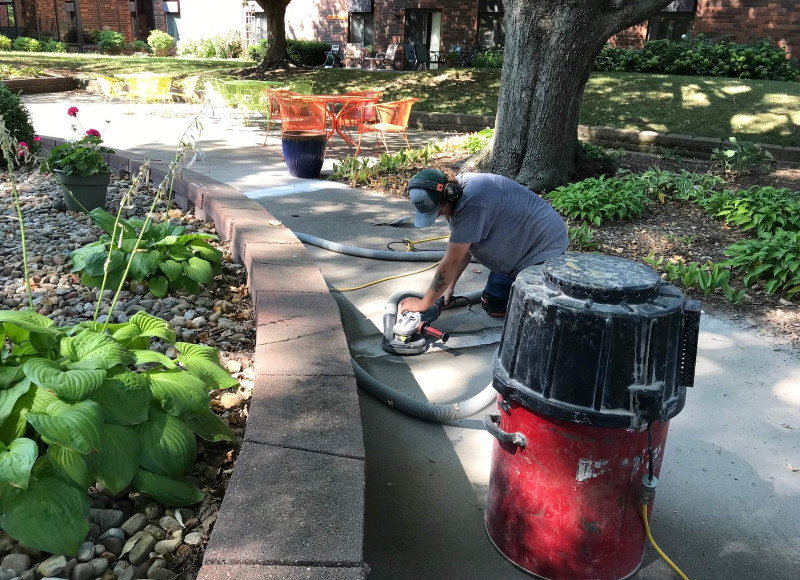
Grinding removes the raised edge. We run diamond-embedded cutting wheels across the high side of the joint and take it down to a smooth, gradual transition, flush with or beveled to the lower slab. Nothing is broken out, and nothing is hauled away.
Our process is virtually dust free, which matters more than it sounds. Grinding next to a storefront entrance, a parked car or a flower bed with an open-air dust cloud is a mess and a breathing problem. Ours is not.
When Grinding Is the Right Call
- Both slabs are structurally sound: no cracks through them, no crumbling, no rocking underfoot
- The problem is a height difference at a joint or crack, not a broken slab
- The height difference is 3/4 inch or less. That is the most we grind off an edge. Past that, too much slab comes off
- You need the hazard gone today. The walk is usable as soon as we pack up. There is no cure time
Where Grinding Falls Short
Grinding takes material off the top. That means it cannot fix a slab that is cracked through, spalling or hollow underneath. Our guide to which concrete cracks to fix and when explains how to tell the difference. It also exposes the stone inside the concrete, so the ground area looks different from the surrounding surface. On a sidewalk nobody cares. On a decorative entry it is worth a conversation first. And if roots are still pushing, the lip may return, which is why we note tree locations on every survey.
What Is Mudjacking, and When Does Lifting Make Sense?
Lifting goes after the opposite problem. Instead of cutting down the high slab, it raises the low one.
Full disclosure: Kelly does not mudjack or polyjack. We grind and we replace. Lifting is in this guide because it is a legitimate fix for the right slab, and if it is the right fix for yours, we will tell you so rather than sell you something else.
Mudjacking (also called slabjacking) drills holes roughly an inch and a half to two inches across through the sunken slab and pumps a cement and soil slurry underneath. The slurry fills the void and hydraulically pushes the slab back up.
Polyjacking does the same job with expanding polyurethane foam through holes closer to 5/8 inch. The foam is far lighter than slurry, cures in minutes rather than a day, and does not add much weight to soil that has already proven it cannot hold much.
When Lifting Is the Right Call
- A slab has sunk as a whole piece and is still in one piece
- There is a void underneath, which often shows up as a hollow sound when you tap it
- The sunken slab now tips water toward your house or garage, and lifting it restores the slope
- The slab is too low for grinding the neighbor to make sense
Where Lifting Falls Short
Lifting does nothing for a slab that was pushed up, which rules it out for most root damage. The drilled holes are patched, and the patches stay visible. A slab with hidden cracks can break during the lift. And if water washed the base out in the first place, lifting without fixing drainage means the new fill can wash out the same way. Mudjacking slurry is also heavy, which can add to settlement on soft soil.
When Is Full Replacement the Only Honest Answer?
Sometimes the slab is past saving, and putting money into grinding or lifting it is paying to delay the inevitable. Replacement is the right call when:
- The slab is cracked through into multiple pieces
- The surface is spalling, flaking and pitting from freeze-thaw and salt
- The height difference is over 3/4 inch, which is more than we grind off an edge
- Roots need to come out, and the slab has to come up to reach them
- The slope is wrong and water is pooling on the walk or running toward a foundation
- It has already been repaired and the same failure came back
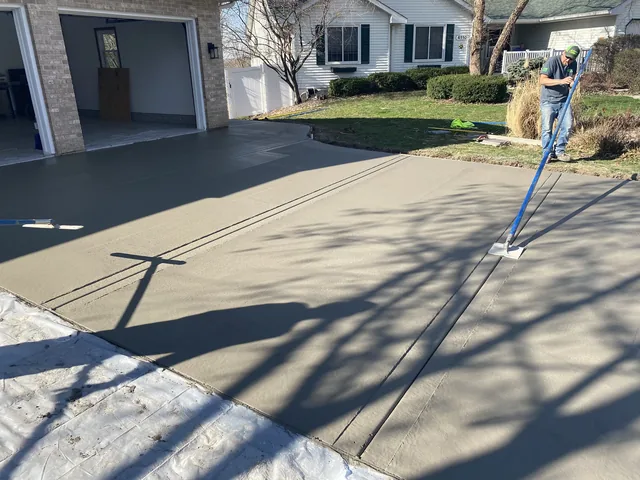
Replacement is the only one of the three that fixes the base. We remove the old concrete, rebuild and compact the base, pour at proper thickness with reinforcement, and cut control joints where the slab should crack. That is a twenty-plus-year decision rather than a two-to-five-year patch. Details are on our concrete sidewalks page, and our guide on when concrete replacement beats one more repair goes deeper on the decision.
How Do Grinding, Mudjacking and Replacement Compare Side by Side?
Here is how the three stack up on the questions people actually ask.
Concrete Grinding
- Fixes: a raised edge up to 3/4 inch on a sound slab
- Does not fix: cracked, crumbling or hollow slabs
- Time on site: minutes to an hour or so per hazard
- Downtime: none; walk on it immediately
- Relative cost: usually the lowest per hazard
- Looks: smooth transition, ground area shows exposed stone
- Lasts: permanent for that edge, unless roots keep pushing
Mudjacking or Polyjacking
- Fixes: a sunken slab that is still in one piece
- Does not fix: slabs pushed up by roots, or broken slabs
- Time on site: typically a few hours
- Downtime: foam is usable quickly; slurry needs longer
- Relative cost: usually between grinding and replacement
- Looks: visible patched holes
- Lasts: depends on whether the cause underneath was addressed
Full Replacement
- Fixes: everything, including the base
- Does not fix: nothing, if the base and drainage are done right
- Time on site: a day or more, plus removal
- Downtime: days before foot traffic, longer for full strength
- Relative cost: the highest up front
- Looks: new, uniform concrete
- Lasts: decades with a properly built base
How Do You Tell Which Fix Your Slab Needs?
You can get most of the way there in five minutes with a tape measure. Walk the sidewalk and ask these questions at every joint:
- Is either slab cracked all the way through? If yes, that slab is a replacement candidate
- Does either slab rock, tip or sound hollow when you step or tap? That points to a void, which means lifting or replacement
- Which slab moved, the high one or the low one? A tree nearby usually means the high one was pushed up. Standing water usually means the low one dropped
- How big is the height difference? Up to 3/4 inch is grinding territory. Over that, the fix is replacement, or lifting if the low slab sank
- Is the surface flaking or pitting? Spalling means the concrete itself is failing, and no edge repair helps
If every slab is intact and the only problem is height, you are probably looking at grinding. If a slab is broken or hollow, you are not. Most properties turn out to be a mix, and the cheapest correct answer is often grinding most joints and replacing one or two slabs.
What Does a Trip Hazard Survey Look At?
When we survey a property, we do not just look for things a grinder can fix. That is the “everything looks like a nail” problem. We document trip hazards, cracks that affect structural strength, spalling, porous or rough surfaces, slope problems, sinking sections and anything else that will become a hazard next. You get a written list of what we found, what we recommend for each item and an estimate. If the right fix for a slab is one we do not offer, such as lifting, the list says that too. See our sidewalk inspection page for what the survey includes.
What Do Property Managers and HOAs Get Wrong About Trip Hazards?
Commercial and association properties have more sidewalk, more foot traffic and more legal exposure. The same mistakes come up on almost every site we survey:
- Fixing only the joint someone complained about. If one slab moved, its neighbors are usually on the way. Survey the whole route
- Painting or coning hazards and calling it handled. See above. Paint is evidence, not a repair
- Waiting for the spring budget. Grinding needs no cure time, so it is not tied to the pouring season the way replacement is. It is best done when there is no frost in the ground, since frost heave can shift slabs temporarily, but late fall and early spring are both open, and an urgent hazard can be ground in winter
- Replacing slabs that only needed grinding. Tearing out a sound slab to fix a half-inch lip spends replacement money on a grinding problem
- Keeping no records. Document what was found, what was fixed and when. If a claim ever comes, a dated repair record is your best friend
For ADA-driven work, our ADA compliance concrete grinding service is built around the Section 303 limits, and commercial trip hazard grinding covers parking lots, entrances and long runs of walk.
Why Have Kelly Look at It?
Most companies that grind only grind, and most companies that pour only pour. Each one has a reason to see their own solution in your sidewalk. We do both.
- In business since 1979, with a dedicated trip hazard grinding division since 2022
- 30+ team members averaging more than ten years with us
- Virtually dust-free grinding with diamond wheels and a smooth finished surface
- BBB Accredited with an A+ rating
- Full-range recommendations. We grind, we repair, we replace, and we will tell you which one you need
Our concrete trip hazard removal page explains the grinding service in detail, and the grinding process page walks through a job step by step. We work in Davenport, Bettendorf, Rock Island, Moline, Silvis, Milan and East Moline.
Frequently Asked Questions
Can you grind a sidewalk that is raised two inches?
No. The most we grind is 3/4 inch. Taking two inches off the edge of a typical four-inch sidewalk would leave it too thin to hold up. At that height the options are replacing one of the two slabs, or lifting the low one if it sank. We do not lift slabs ourselves, but we will tell you when lifting is the better call.
Does grinding weaken the slab?
Not within our 3/4 inch limit. We take material off a small area at the edge, not across the slab. When a hazard is taller than that, we recommend a different fix.
Will the slab move again after grinding?
The ground edge stays put. Whether the slab moves again depends on the cause. Settled base and finished frost movement are usually stable. An active tree root may keep pushing, and we will point that out.
Is polyjacking better than mudjacking?
Foam uses smaller holes, weighs less and cures faster, which helps on soft soil. Slurry is heavier and needs more cure time. Neither one fixes a drainage problem that caused the settling.
How soon can people walk on it?
After grinding, immediately. After foam lifting, usually within the hour. After replacement, generally 24 to 48 hours for foot traffic, and we give you the specific timeline for your pour.
Can trip hazard grinding be done in winter?
Yes, but it is best done when there is no frost in the ground. Frost can heave a slab temporarily, so an edge ground flush in January may not sit flush in April. Grinding involves no curing, so cold alone does not stop it the way it stops a concrete pour. If a hazard cannot wait, we grind it.
The Next Step Is a Tape Measure or a Phone Call
Measure your worst joint tonight. If it is over a quarter inch on a commercial property, or over a half inch anywhere people walk, it is worth fixing before someone finds it with their toe.
Call (563) 388-9529 or request a Trip Hazard Survey online. We are open Monday through Thursday, 7am to 4pm, and Friday 7am to noon. We will tell you whether your sidewalk needs grinding, replacement or nothing at all, and if lifting is the better fix, we will tell you that too.
New. Remove. Improve.