If you’ve been researching garage floor coatings, you’ve probably done what most Quad Cities homeowners do: ask around, read threads online, get a couple of quotes, and end up more confused than when you started. The prices don’t match. One contractor says epoxy, another says polyurea. One quotes $900, another quotes $4,000 for the same floor.
Here’s the short version: the coating material matters, but prep is everything. A cheap job done wrong will peel, flake, and fail within a year. A good job done right will last decades. The difference between those two outcomes almost always comes down to one thing that never shows up in the brochure.
What Is Diamond Grinding and Why Does It Determine Everything?
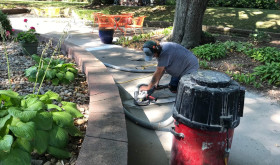
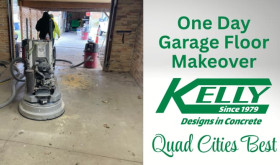
Before any coating touches your slab, the concrete has to be prepared. Diamond grinding is the industry-standard method for opening up the concrete surface so the coating can bond to it. A diamond-embedded disc on a grinder mechanically abrades the top layer of the slab, removing laitance (the weak surface film that forms when concrete cures), contaminants, and old sealers.
The alternative is acid etching, which some contractors use because it’s faster and cheaper. The problem is that acid etching is inconsistent. It doesn’t create the uniform surface profile that grinding does, and on a slab that’s been sealed, stained by oil, or poured with a tight finish, etching often does almost nothing.
Homeowners who’ve been through bad installs describe it clearly: “The prep work is more important than the product itself.” And: “Bad prep equals a bad floor.” That’s not exaggeration. It’s what we see when we’re called out to redo a floor that was done by someone who skipped grinding.
What to ask any contractor before you sign:
- What is your prep method?
- Do you use diamond grinding or acid etching?
- What grit are your grinding discs?
- Do you use a HEPA vacuum during grinding?
If they hesitate on any of those, or if “grind” isn’t the first word out of their mouth when you ask about prep, keep looking.
Epoxy vs. Polyurea vs. Polyaspartic: Which One Do You Actually Want?
This is where most homeowners get lost. The coating market is full of overlapping terminology, and contractors don’t always help by using the terms interchangeably when they’re not the same product.
Here’s a straight comparison:
Epoxy
- Cure Time: 24-72 hours
- UV Stability: Yellows over time
- Flexibility: Rigid; can crack with slab movement
- Typical Cost: Lower
Polyurea
- Cure Time: 1-3 hours
- UV Stability: UV stable
- Flexibility: More flexible than epoxy
- Typical Cost: Mid to high
Polyaspartic
- Cure Time: 1-4 hours
- UV Stability: UV stable
- Flexibility: Flexible
- Typical Cost: Mid to high
Polyurea and polyaspartic coatings have largely replaced epoxy as the professional standard for garage floors. Both cure faster, handle temperature swings better, and resist UV yellowing. In a Midwest climate, this matters. Eastern Iowa winters mean temperature cycling, road salt tracked in on tires, and moisture from snow melt. Epoxy doesn’t love any of that.
The real-world consensus from homeowners who’ve lived with these floors: “Do the poly, it’s much stronger and lasts longer if you can afford it.”
What “one-day coating” means: A professional polyurea or polyaspartic system can be fully installed and cured in a single day because the cure time is measured in hours, not days. You drive your car back in that evening. That’s a genuine advantage of the newer coating chemistries, not just a marketing claim.
What Does Garage Floor Coating Actually Cost in Eastern Iowa?
Price is where homeowners hit the most friction. The range is wide, and the reasons for it aren’t always obvious.
The general market range for a professionally installed polyurea or polyaspartic system runs $7 to $9 per square foot as a national benchmark, which maps closely to what Midwest installers charge for a correctly spec’d job. A standard two-car garage (400-500 sq ft) typically falls between $3,000 and $4,500 depending on the condition of the slab, the chip pattern chosen, and whether any crack repair or leveling is needed before coating.
What drives price up:
- Slab in poor condition requiring significant prep work
- Leveling or crack injection before coating
- Custom chip blends or metallic finishes
- Larger garage footprints (triple car, tandem bays)
What makes a quote suspiciously low:
- No mention of grinding (they’re etching instead)
- No HEPA vacuum during grinding (creates bonding problems)
- No warranty, or a very short one
- Single-coat application (a quality system uses a base coat, broadcast, and top coat)
A quote at $900 for a two-car garage is a red flag, not a deal. That price point typically means cut corners on prep, thin material coverage, or a product that won’t hold up to a Midwest winter. “Run far away from the $900 quote” is blunt advice, but it comes from people who learned the hard way.
How Do Iowa Winters Affect Your Garage Floor Coating?
This is a specific concern for Eastern Iowa homeowners that generic coating content doesn’t address honestly.
The main threats to a coated floor in a Midwest climate are:
- Freeze-thaw cycles acting on the slab beneath the coating
- Road salt and deicers tracked in on vehicles
- Snow melt pooling on the floor before it drains or evaporates
A properly installed polyurea system handles all of these well. The coating bonds tightly enough to move with minor slab flexing, it’s chemically resistant to salt and deicers, and the sealed surface prevents moisture from wicking into the concrete.
The key caveat is installation temperature. Most coating systems have a minimum application temperature, usually around 50 degrees Fahrenheit. Installers working in Iowa need to plan around that window. Spring and fall are ideal. Midsummer works. Installing in an unheated garage in February is a mistake regardless of what the product label claims.
Moisture in the slab is the other factor. A slab that hasn’t fully cured, or one with an active vapor transmission problem, will cause bonding failure even with perfect surface prep. A competent installer tests for moisture before coating. If yours doesn’t mention it, ask.
What Does a Legitimate Estimate Look Like?
Homeowners consistently report the same frustration: quotes that are a single number with no explanation of what’s included. Here’s what a transparent, line-item estimate should cover:
- Square footage being coated (measure it yourself so you can verify)
- Prep method specified (diamond grinding, grit level)
- Base coat product name and coverage rate
- Chip blend or decorative layer
- Top coat product name, coverage rate, and thickness
- Warranty terms (labor and material, separate or combined)
- Timeline and number of days to completion
- What’s excluded (e.g., slab repair, expansion joint sealing)
If crack repair or leveling is needed, that should be a separate line item with its own price, not buried in the base quote. A good contractor will tell you what they’re seeing before you commit.
Common Mistakes Homeowners Make When Hiring a Coating Contractor
Getting only one quote. Prices vary significantly enough that a single quote gives you no frame of reference. Get at least three.
Choosing on price alone. The cheapest bid is almost never the best value in this category. Prep shortcuts and thin material aren’t visible in the quote, but they show up six months after installation.
Not asking about the warranty. A warranty tells you how confident the contractor is in their own work. A one-year warranty on a product that should last 15 to 20 years is not a strong signal. Ask what the warranty covers, for how long, and whether it’s transferable if you sell the house.
Skipping the moisture test. Ask whether your installer tests for moisture vapor transmission before applying a coating. It’s a quick test and a legitimate step. Skipping it on a slab with moisture issues leads to delamination.
Assuming all polyurea products are equal. They’re not. There are commercial-grade polyurea products and consumer-grade ones. Ask your installer what brand they’re using and whether they can show you the technical data sheet.
Why Local Experience Matters for Quad Cities Floors
Eastern Iowa slabs have their own character. The soil conditions in the Quad Cities area, combined with the temperature cycling common to the Mississippi River corridor, mean that slabs here settle and move differently than in drier climates. A contractor who’s been working in Davenport, Bettendorf, Moline, and Rock Island for years has seen more local slab behavior than someone who just brought a national franchise to town.
Kelly Designs in Concrete has been working with Quad Cities concrete since before garage floor coatings were a product category. We’ve seen what proper prep looks like, what corners look like when they’re cut, and what a floor looks like five years after each kind of installation. When we quote a job, we tell you what we’re going to do and why.
Frequently Asked Questions About Garage Floor Coating
How long does a polyurea garage floor coating last?
A professionally installed polyurea system applied over a properly prepared slab will typically last 15 to 20 years with normal residential use. Longevity depends heavily on prep quality, the number of coats applied, and the product used. Systems with a commercial-grade top coat and a broadcast decorative layer generally outperform single-coat epoxy by a wide margin.
Can you coat a garage floor in winter in Iowa?
Most coating systems require a minimum ambient and surface temperature of around 50 degrees Fahrenheit. In an unheated garage, that limits installation to the warmer months in Eastern Iowa. If your garage is heated or insulated, winter installation may be possible, but your contractor should confirm surface and substrate temps before proceeding.
What happens if the coating starts to peel?
Peeling almost always traces back to adhesion failure caused by inadequate prep, an incompatible product applied over an existing coating, or a moisture problem in the slab. If the floor was installed correctly with diamond grinding and the slab was clean and dry at the time of application, peeling is rare. If it does occur within the warranty period, the contractor is responsible for the repair.
Is a one-day coating the same quality as a multi-day installation?
Yes, when polyurea or polyaspartic products are used. These systems are engineered for fast cure times. The quality is determined by the prep, the product, and the installation technique, not the number of days the job takes.
Do I need to move everything out of my garage?
Yes. The floor needs to be fully cleared for grinding and coating. Your installer can usually help you plan the logistics, and because the cure time on polyurea is measured in hours, you can typically return vehicles to the garage the same evening.
What is the difference between flake and solid color coatings?
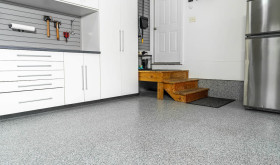
A flake system uses vinyl flake broadcast over a wet base coat, then sealed with a clear top coat. It hides imperfections well, adds texture for slip resistance, and is the most popular residential finish. Solid color systems are cleaner-looking but show imperfections in the slab more clearly and can feel slippery when wet without an anti-slip additive.
Ready to Get a Straight Answer on Your Garage Floor?
Kelly Designs in Concrete serves the Quad Cities area, including Davenport, Bettendorf, Moline, and Rock Island. We use diamond grinding on every job. We test for moisture. We give you a line-item quote with product names, not a single number and a handshake. Our polyurea installations come with a warranty worth reading.
Call us at (563) 388-9529 or see our garage floor coating services to request a free estimate.