Most people do not call a concrete contractor the first time they notice a crack. They notice it in April, decide it can wait, and then notice it again the following April, a little wider. That is not procrastination. That is a completely reasonable response to a question nobody has answered for them: is this normal aging, or is this the beginning of something expensive?
We get that call every week, usually from someone standing in their driveway holding a phone, apologizing for not knowing what they are looking at. You do not need to apologize. Concrete is one of the few things on your property that fails slowly enough to be easy to ignore and fast enough to surprise you.
This guide is meant to give you the same read on your slab that we would give you in person, so that whatever you decide, you decide it on purpose.
What Concrete Is Actually Telling You
Concrete does not fail randomly. It fails in patterns, and each pattern points to a different cause underneath.
The single most useful thing to understand is this: the slab is rarely the real problem. The slab is the messenger. What is happening below it, in the compacted base and the soil beneath that, is usually the story.
In eastern Iowa and western Illinois we get roughly 100 freeze-thaw cycles in an average winter. Water gets into the concrete, expands about nine percent when it freezes, and pushes the material apart from the inside. Do that a hundred times a year for twenty years and the surface starts to give up. Add road salt, which accelerates the process, and you have the Quad Cities concrete lifecycle in a sentence.
How Do I Read the Damage on My Own Slab?
Here is what different damage patterns typically mean:
- Hairline cracks in a fairly straight line are usually shrinkage cracks from the original cure. Common, mostly cosmetic, and often not urgent on their own
- Cracks wider than a quarter inch, especially with one side sitting higher than the other, point to movement in the base. This is settlement, and it will continue
- Spalling, where the top surface flakes, pits, or peels away like the skin of an orange, means the concrete itself is deteriorating from freeze-thaw and salt exposure. Surface repair on a spalling slab is temporary by definition
- A network of interconnected cracks resembling a dried lakebed is called map cracking or crazing, and it indicates the slab has lost structural integrity across its area
- Standing water that sits for more than a day after rain means the slope has changed. Water that does not leave is water working its way underneath
- Sections that rock, tip, or sound hollow underfoot mean there is now a void beneath the slab. The base has washed out or settled away
If you have one crack, you likely have a repair. If you have three or more of the signs above appearing together, you are looking at a slab whose foundation has moved, and no surface treatment fixes a foundation problem.
Repair or Replace: An Honest Comparison
We repair concrete. We also remove and replace it. We have no incentive to push you toward the larger job, and we would rather tell you to wait two years than sell you something that will not solve your problem.
Here is the framework we actually use.
When Does Repair Make Sense?
- The damage is isolated to one or two areas rather than spread across the surface
- The slab sits level, with no rocking, tipping, or height differences between sections
- Cracks are narrow and stable, meaning they have not measurably widened over a couple of seasons
- The surface is sound, with no widespread flaking or pitting
- The concrete is under roughly twenty years old and was well installed to begin with
- The problem is a trip hazard at a joint, which can often be ground flush rather than replaced at all
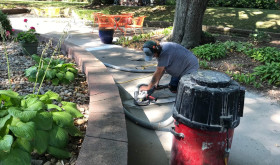
That last point deserves emphasis, because it saves people real money. A raised edge where two sidewalk sections meet is the most common defect we see, and it is frequently solvable without breaking anything. Our concrete trip hazard removal service grinds the high side down to a smooth transition, virtually dust free, usually in a single visit. If your sidewalk is otherwise in good shape and the only issue is a lip you keep catching your toe on, start there, not with replacement.
When Does Replacement Make Sense?
- Damage appears across the majority of the surface rather than in one spot
- Multiple sections have settled to different heights
- The surface is actively spalling and losing material each season
- Drainage has reversed and water now flows toward your home or garage
- You have already repaired this area once and the same failure has returned
- The slab has voids beneath it, or sounds hollow when walked on
- The concrete is roughly thirty years old or more and showing several signs at once
The honest math matters here. When repair costs approach half the price of replacement, and the underlying cause has not been addressed, replacement is nearly always the better value. A repair buys you two to five years on a compromised slab. A properly installed replacement, with the base rebuilt underneath it, is a thirty-year decision.
There is one more question we ask every homeowner: how long do you plan to be in this house? If the answer is two years, we will talk about the most cost-effective way to make the property safe and presentable. If the answer is twenty, spending money twice on the same slab rarely makes sense.
Driveways: The Highest-Stress Concrete on Your Property
Your driveway carries more weight, more thermal cycling, and more salt than anything else you own in concrete. It is also the first thing anyone sees.
Why Do Driveways Fail First?
A residential driveway takes the full load of vehicles, delivery trucks, and occasionally a dumpster or a moving truck the original installer never planned for. Meanwhile the surface is fully exposed to sun, rain, snow, and every bag of ice melt applied to it.
The most common failures we see in Davenport, Bettendorf, and across the river:
- Edge crumbling, where the outer twelve inches break away because the slab was poured without adequate edge thickness or base support
- Settlement near the garage apron, often because backfill around the foundation was never properly compacted when the house was built
- Longitudinal cracking down the length of the drive, typically from insufficient thickness for the loads it carries
- Deterioration at the street, where snowplow contact and municipal salt hit hardest
What Does Proper Driveway Replacement Involve?
This is where contractors genuinely differ, and where the invisible work determines whether you get twelve years or forty.
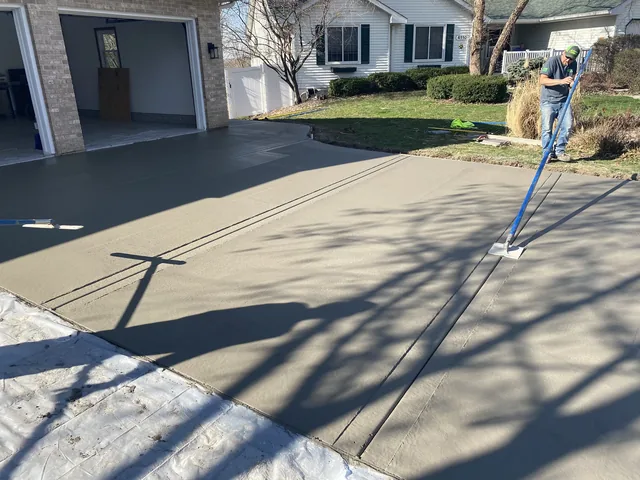
- Full removal and haul-off. The old slab comes out completely. Pouring new concrete over old is a shortcut that transfers every existing problem into the new surface
- Base evaluation and rebuild. This is the step that separates a lasting driveway from an expensive one. We excavate to proper depth, evaluate what is actually under there, and rebuild with compacted granular base. If the base caused the original failure and the base is not corrected, the new slab will fail the same way
- Correct thickness for actual use. A residential driveway should be a minimum of four inches. Where trucks, RVs, or trailers park, more. Thickness is not where to economize
- Reinforcement. Rebar or wire mesh, placed properly within the slab rather than laid on the ground and poured over, which does nothing
- Proper jointing. Control joints cut at the right depth and spacing tell the concrete where to crack. Concrete will crack. Good jointing means it cracks where you planned instead of across the middle of your drive
- Drainage and slope. Water must move away from your foundation and garage. We set slope deliberately, because a driveway that drains toward the house creates a much more expensive problem than the one you started with
- Proper curing. Concrete does not dry, it cures through a chemical reaction, and that reaction needs time and moisture control. Rushing it produces a weak surface that spalls early
Full detail on our approach is on the concrete driveways page.
What Should I Consider While the Driveway Is Open?
If you are already replacing, this is the moment to consider whether you want plain gray or something better. Stamped concrete and decorative concrete finishes cost meaningfully less when integrated into a pour you are already doing than they ever will as a future project. Our graduate landscape architect on staff can show you how the driveway relates to the rest of your property before anything is poured. That is not a service most concrete contractors offer, and it is the difference between a replaced driveway and a genuinely improved one.
Sidewalks and Walkways: Where Safety Enters the Picture
Sidewalks carry almost no weight compared to a driveway. They fail for a different reason, and they carry a different kind of risk.
Am I Liable for the Sidewalk in Front of My House?
If someone falls on the public sidewalk in front of your home or business, responsibility may fall on you. Many Quad Cities municipalities place sidewalk maintenance on the adjacent property owner, and cities do issue repair notices with deadlines attached.
This is not meant to alarm you. It is meant to reframe a project that often gets deferred as cosmetic. A raised sidewalk edge is a safety issue with a deadline, not a landscaping preference. For commercial properties there is an additional dimension, since walkways serving the public generally need to meet ADA accessibility standards, including vertical changes limited to a quarter inch. Our ADA compliance concrete grinding service exists specifically for that requirement.
Why Do Sidewalks Move?
- Tree roots are the leading cause. A maturing root system lifts sections several inches over time
- Base washout, where water traveling alongside the walk carries away the supporting material until the section drops
- Freeze-thaw heaving, which lifts and lowers sections through the winter until they no longer sit level with each other
- Original installation on uncompacted fill, which settles gradually for years afterward
Should I Grind or Replace an Uneven Sidewalk?
For sidewalks the choice is genuinely close, so here is our plain answer.
Grinding is the right call when the sections are sound and the only problem is a height difference at the joints. It is faster, costs a fraction of replacement, creates no debris to haul away, is virtually dust free, and eliminates the hazard the same day. If your walk is structurally fine but uneven, grinding is not the cheap option, it is the correct one.
Replacement is the right call when sections are cracked through, crumbling, badly sloped, or so lifted that grinding would remove too much material to leave adequate thickness. Roots that have destroyed a section rather than simply lifted it require replacement, and root management as part of the work.
We will tell you which one you have. Sometimes the answer is both, replacing two failed sections and grinding the rest. See concrete sidewalks and concrete walkways for how each is handled.
Timing Your Project in the Quad Cities
Concrete is seasonal work, and our climate narrows the window more than people expect.
- Spring, April through June, is prime season. Temperatures are workable and the slab has months to cure before its first freeze. It is also when everyone else calls, so schedules fill
- Summer works well, though extreme heat requires adjusted practices to keep concrete from curing too quickly at the surface
- Early fall, through roughly mid-October, is often the best-kept secret. Ideal curing temperatures, and schedules have loosened after the summer rush
- Late fall and winter are constrained. Concrete needs sustained temperatures above about 40 degrees to cure properly, and once ground frost sets in, base preparation becomes unreliable
The practical takeaway: if you notice a problem in fall, call then rather than waiting for spring. You may fit into the current season, and if you do not, you are near the front of the spring schedule instead of somewhere in the middle of it.
Why Quad Cities Homeowners Choose Kelly
We have been doing this in the Quad Cities since 1979. Forty-seven years in one market means our work is inspectable, and a fair amount of it is still in the ground doing its job.
- 500+ projects completed, across residential and commercial properties throughout the region
- 30+ team members averaging more than ten years with us. The crew at your house is not a rotating cast of subcontractors
- BBB Accredited Business with an A+ rating
- LocalsLoveUs #1 Concrete Contractor in the Quad Cities
- A graduate landscape architect on staff, so your concrete can be planned in relation to your whole property rather than in isolation
- We do the full range, so our recommendation is not shaped by which service we happen to sell. We grind, we repair, and we replace. That means we can genuinely tell you when replacement is unnecessary
We serve Davenport, Bettendorf, Rock Island, Moline, Silvis, Milan, and East Moline. Find your city on our service areas page.
Frequently Asked Questions
How long should a concrete driveway last in the Quad Cities?
A properly installed driveway with an adequate compacted base typically lasts 30 or more years here. Ones that fail at 12 to 15 years almost always failed at the base, not the surface. Freeze-thaw cycling and road salt are the two factors that most shorten that lifespan.
Can you pour new concrete over an existing driveway?
We do not recommend it. Overlaying traps whatever caused the original failure underneath, and the new surface generally cracks along the same lines within a few years. It also raises the grade, which can interfere with garage door clearance and change how water drains.
Is grinding really as good as replacing a raised sidewalk section?
For a height difference at a joint, yes, provided the sections themselves are sound. Grinding removes the hazard permanently and leaves a smooth transition. What it cannot do is repair a section that is cracked through or crumbling. We assess and tell you which situation you have.
How long before I can drive on a new driveway?
Foot traffic is generally fine after 24 to 48 hours. Passenger vehicles typically after 7 days. Heavy vehicles, trailers, or RVs should wait a full 28 days, when concrete reaches its designed strength. We give you the specific timeline for your pour, since weather affects it.
Will new concrete match my existing concrete?
New concrete will be lighter and will not match immediately. It lightens as it cures, then gradually weathers toward the surrounding surfaces over one to two years. If matching matters, we can discuss color options during planning.
Am I responsible for the public sidewalk in front of my property?
In most Quad Cities municipalities, yes, maintenance of the adjacent public sidewalk falls to the property owner, and cities do issue notices with compliance deadlines. Rules vary between Iowa and Illinois jurisdictions, so check with your city. If you have received a notice, bring it when we come out.
Do you provide free estimates?
Yes. We come out, look at the actual conditions, and give you a written estimate. If we think you should repair rather than replace, or wait a season, we will tell you that.
The Next Step Is Just a Look
You do not have to decide anything today. What is genuinely worth doing is finding out what you are actually dealing with, because the difference between a grinding job and a full replacement is large, and you cannot reliably tell which one you have from a photo.
Call (563) 388-9529 or request an estimate online. We are open Monday through Thursday, 7am to 4pm, and Friday 7am to noon.
Whether the answer is replacement, a repair, or leaving it alone for another two years, you will know where you stand. That is worth a phone call on its own.
New. Remove. Improve.
« Garage Floor Coating Eastern Iowa | What to Know Before You BuyWhy Garage Floors Peel in Iowa Winters (and What Actually Survives Road Salt) »