Every spring we get calls from people whose garage floor is coming up with their tires. They did everything the box told them to. They cleaned the slab, they used the etching packet, they rolled it on a warm Saturday and let it sit the recommended time. Two winters later it is peeling off in sheets.
The coating did not fail because they did it wrong. It failed because epoxy is the wrong material for a garage floor in this climate, and no amount of careful application fixes a material mismatch.
That is an annoying answer if you already spent a weekend on it. But it is worth understanding before you spend another one, because the failure is predictable, and so is the fix.
What Actually Kills a Garage Floor Coating
Three things destroy coatings in the Quad Cities, and they arrive together every winter.
Hot tire pickup. Your tires heat up on the drive home. You pull into the garage and park a hot, soft tire against a cured coating. Epoxies typically soften slightly under that heat, and the tire can end up bonded to the coating better than the coating is bonded to the concrete. Back out the next morning and the coating comes with you, in a shape that matches your tire tread. It is the single most recognisable garage floor failure, and it is why the coating you choose matters more than how carefully you rolled it on.
Road salt. Iowa and Illinois DOT crews put down a lot of chloride. You carry it home in the wheel wells and it drips onto your floor as the snow melts. Chlorides attack the bond line between coating and concrete, and they keep working all winter.
Moisture vapor from below. This is the one nobody accounts for. Concrete is not waterproof. Ground moisture moves up through the slab as vapor, constantly. If your slab has no vapor barrier under it, which most garages poured before the mid-1990s do not, that vapor pushes against the underside of whatever you put on top. A coating with low permeability traps it, pressure builds, and the coating lifts. This is why a coating can fail in the middle of the floor where no tire ever parks.
Add freeze-thaw cycling to all three and you have a material problem, not an application problem.
Epoxy vs Polyaspartic: The Real Comparison
Both are called garage floor coatings. They behave nothing alike.
Cure Time and Working Window
Epoxy cures slowly. Product instructions vary, but consumer and trade epoxies typically call for something like 12 to 24 hours between coats, and often around 5 to 7 days before vehicle traffic. Check the specific product, because they differ. In a two-car garage that generally means the better part of a week with your cars sitting outside, in whatever weather is happening.
The Penntek basecoat reaches tack free in roughly 2.5 to 4 hours. The whole system goes down in one working day, and you are back to normal use the following day rather than the following week.
Worth being straight about the details, because they vary. The topcoat’s tack free time swings with the formulation and the weather: the Winter version is 1.5 hours, Summer is 8 hours, and the Extreme Heat version is 10.5 hours. In practice that means we grind and coat in a single day, but when you can walk on it that evening versus the next morning depends on the season. We tell you the actual timeline for your install rather than a slogan. Either way it is one day of work and one night of waiting, against a week of parking outside for epoxy.
Temperature Range
Most epoxies specify a minimum around 55 to 60 degrees, though this varies by product and some winter-grade formulations go lower. Below the rated minimum, epoxy typically cures slowly and soft or does not fully cross-link. For an unheated Quad Cities garage, that generally puts a standard epoxy install somewhere in the May through September window.
Penntek makes three temperature-specific formulations, and the Winter version of the XP 275 basecoat is rated for application from 30 to 60 degrees. That is the practical difference: we are not waiting for a 60 degree week. There is a separate requirement that matters more than air temperature, which is that the floor itself has to be more than 5 degrees above the local dew point, or condensation forms on the slab and the bond suffers. We check that on site.
UV Stability
Standard epoxies tend to amber. Sunlight coming through an open garage door yellows them, unevenly, following the light. A white or light gray epoxy floor can look noticeably dingy within a few years, and it is not dirt, it is the resin itself changing color. UV-stable epoxy formulations do exist, so this is a question to ask about a specific product rather than an absolute rule.
Penntek specifies the NX 300 topcoat for excellent UV stability, and that is the layer taking the sunlight. It also comes off the roller at high gloss, 90 units measured at 60 degrees, which is a mirror finish rather than a sheen.
Abrasion and Chemical Resistance
The topcoat is where the hardness lives. NX 300 reaches a König hardness of 145 seconds at full cure, against 31 seconds for the basecoat underneath it, and Taber abrasion testing on CS-17 wheels under a 1000 gram load shows a loss of 65 milligrams per 1000 cycles. In plain terms, that is a surface built to take dragged toolboxes, dropped wrenches, and tires turning on it.
The two layers are doing different jobs, which is the point of a system. The basecoat is the flexible one, with 95 percent elongation, so it moves with the slab through freeze-thaw. The topcoat is the hard one, at 5 percent elongation and 5000 PSI tensile. Grip and give underneath, armor on top.
Penntek publishes spot testing on the NX 300 topcoat, which is the layer you actually park on and spill on. It is worth being precise about what that data shows rather than waving at “chemical resistant.”
The everyday spills score a 5, meaning no damage, even after 24 hours: motor oil both conventional and synthetic, antifreeze, ice melt at 20 percent, mineral spirits, sodium hydroxide, citric acid, coffee, cola, ketchup, glycerin, and water. For a garage floor in a road salt climate, ice melt scoring no damage after a full day of contact is the number that matters most.
The more useful column is the 30 minute result, because it tells you what happens if you clean up a spill promptly instead of finding it the next morning. Brake fluid rates a 2 at 24 hours but a 5 at 30 minutes. Gasoline goes from a 2 to a 3. Wipe it up and there is no lasting mark. Leave it overnight and there is.
A few things do mark it regardless. Acetone, 30 percent acetic acid, 20 percent hydrochloric acid, and 99 percent isopropyl alcohol all rate a 1 at 24 hours, meaning damage that does not recover. Those are not typical garage spills, but if you run a shop, that is worth knowing. Anyone telling you a coating shrugs off everything is selling, not informing.
Moisture Tolerance
This is the decisive one for older Quad Cities homes, and it is where we have to be careful not to overstate the material.
The two layers test very differently. The NX 300 topcoat comes in at 3.2 perms, which is reasonably breathable. The XP 275 basecoat underneath it is 0.78 perms, which is not. The basecoat is the layer sitting against your concrete, so that is the number that governs, and it means the system is not a membrane that lets your slab freely breathe. Any contractor who tells you polyaspartic solves moisture problems by itself is skipping a step.
What actually protects the floor is testing before we coat. Penntek specifies it: for residential work the slab is checked with a non destructive meter per ASTM F2659, and the reading must not exceed 5.5 percent. Between 5.5 and 6.5 percent the system requires a primer, either NF 450 or Veritek MP, underneath the basecoat. Above 6.5 percent the answer is to consult Penntek technical support rather than proceed. Commercial and industrial slabs get in situ relative humidity testing to ASTM F2170 instead.
On a 1970s slab with no vapor barrier, that testing step is the whole outcome. It determines whether your floor gets a primer, a different system, or a recommendation to fix the moisture source first.
The Honest Case for Epoxy
Epoxy is cheaper per square foot, and on a newer slab in a climate-controlled, heated garage that never sees road salt, it performs acceptably. If you are coating a basement floor or a heated workshop that stays above 55 degrees year round and cars do not drive on it, epoxy is defensible.
That is not most Quad Cities garages.
Why the Preparation Matters More Than the Coating
You can put the best coating in the world on a badly prepared slab and it will fail. Preparation is the majority of what you are paying for, and it is the step DIY kits cannot replicate.
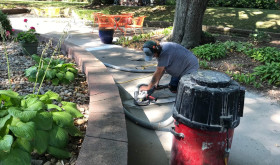
- Diamond grinding, not acid etching. The kits include an etching packet because acid is shippable and grinders are not. Acid roughens the surface unevenly and leaves residue that has to be neutralized and rinsed, which introduces water. We grind mechanically with diamond tooling to open the concrete to a consistent profile across the entire floor. That profile is what the coating mechanically keys into.
- Moisture testing. We test the slab before quoting, to ASTM F2659 on residential work. Under 5.5 percent we proceed. Between 5.5 and 6.5 percent the floor needs a primer under the basecoat. Above that, we stop and talk to Penntek rather than coat it and hope. Skipping this step is how a correctly installed floor fails anyway.
- Crack and joint repair. Cracks get chased out, filled, and made structurally sound before anything is coated. Coating over a moving crack just telegraphs it through the new surface within a season.
- Oil and contaminant remediation. Decades of drips soak into concrete. Contaminated areas get treated and, where necessary, ground deeper. Coating over oil-saturated concrete produces a bond that fails in patches.
- Full vacuum extraction. Grinding produces dust, and dust between the concrete and the coating is a release layer. Everything comes up before the first coat goes down.
If a quote does not describe mechanical grinding, ask what the preparation actually is. The answer tells you most of what you need to know.
What a One-Day Installation Looks Like
- Morning. Everything comes out of the garage. We grind the full floor, chase and fill cracks, and treat contaminated areas. The floor gets vacuumed.
- Midday. Base coat goes down, rolled to a uniform 5 to 6 mils. On a full-flake system the decorative vinyl flake is broadcast into the wet base to refusal, meaning until the surface will not accept any more. This is timed work: Penntek specifies broadcasting within 15 minutes of the mix, so crews mix only what they can place in that window. Broadcasting to refusal is what produces an even appearance rather than a blotchy one.
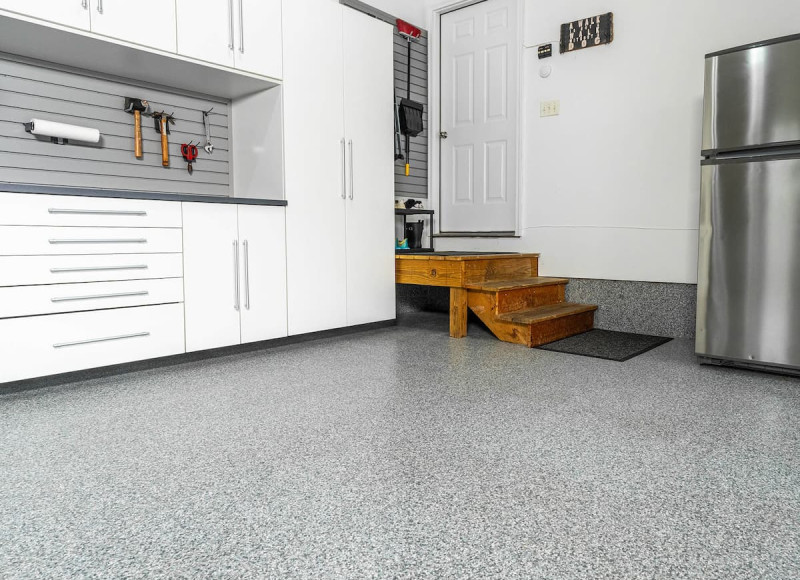
- Afternoon. Excess flake is scraped and vacuumed, then the NX 300 polyaspartic topcoat goes on, spread with a squeegee and back rolled to 7 to 8 mils. This is the layer you actually walk on, and it carries the gloss, the UV stability, the abrasion resistance, and the chemical resistance.
- That evening or the next morning. Foot traffic, once the topcoat is tack free. In winter conditions that is about 90 minutes after the topcoat goes down. In summer heat it can be 8 to 10 hours, which puts it into the following morning.
- Next day. Park on it.
Details on the process are on our one-day garage floor system page, and the material itself on polyaspartic floor coating.
What to Ask Any Contractor You Call
You do not have to take our word for the preparation argument. Ask whoever you are considering, including us:
- Do you diamond grind or acid etch? Grinding is the answer you want
- Do you moisture test the slab before quoting? If they have not tested, the quote is provisional whether they say so or not
- What exactly does the warranty cover, and who issues it? Product and workmanship are separate. Get both in writing
- Is the topcoat polyaspartic, or is it epoxy with a polyaspartic topcoat? Hybrid systems exist and are sold as polyaspartic floors. They inherit epoxy’s moisture behavior at the bond line
- How many coats, and what is the flake broadcast? Broadcast to refusal produces even coverage. A light broadcast looks sparse and shows wear patterns sooner
A contractor who answers these directly is one you can evaluate. Vague answers about “commercial grade” and “industrial strength” are not specifications, they are adjectives.
Where Kelly Fits
We are the only Penntek certified polyaspartic installer in the Quad Cities. Certification means Penntek trained our crews on their system and stands behind the material when it is installed to their specification.
Penntek coatings carry a limited lifetime warranty on the product. Our installation workmanship is warranted separately by us. Those are two different warranties from two different parties, and any contractor who blurs them together is telling you something imprecise. We will walk you through exactly what each one covers before you sign anything.
We have also been named a LocalsLoveUs award winner for Garage Flooring in the Quad Cities, alongside our #1 Concrete Contractor ranking.
What that adds up to in practice: 500+ projects completed since 1979, and 30+ team members averaging more than ten years with us. The crew grinding your floor has done this work for years, on this side of the river, in these winters.
We serve Davenport, Bettendorf, Rock Island, Moline, Silvis, Milan, and East Moline. See service areas for your city.
Living With a Polyaspartic Floor
People ask what the upkeep is, expecting a list. It is genuinely short.
Sweep it or blow it out when it gets gritty, because grit underfoot is the only thing that will meaningfully abrade the surface over years. Wet mop with warm water when it needs it. A neutral pH cleaner is fine for oil or grease.
What to avoid is a shorter list still. Do not use products containing citrus or acid, which can dull the finish over time. Do not drag steel toolbox corners or jack stands across it without something underneath, because impact resistance and gouge resistance are not the same property. If you do body work or run a welder in the garage, put a mat down where sparks land.
Road salt does not need to be scrubbed off urgently the way it does on bare concrete. The coating is what the salt is sitting on, and it is not absorbing anything. Rinse it when convenient.
There is nothing to reseal and nothing to strip and reapply. That is the practical difference from a sealed or polished bare slab, which needs periodic re-treatment. A correctly installed polyaspartic floor is finished.
One Thing to Check First
A coating is a surface treatment. If your slab itself is failing, spalling, heaving, or cracked through, a coating will not fix that and will not last on it.
If your garage floor has deep structural cracking or sections at different heights, the honest answer is that you are looking at concrete replacement first, then a coating on the new slab. We will tell you that when we come out rather than taking the coating job and letting you discover it in two years.
Frequently Asked Questions
How much does a polyaspartic garage floor cost in the Quad Cities?
It depends on square footage, the current condition of the slab, and how much crack repair and contaminant remediation the floor needs. A clean two-car slab quotes very differently from one with oil saturation and structural cracking. We do not publish a per-square-foot number because a figure without seeing the floor is a guess. We look at it and give you a written price before any work starts. The estimate is free.
Can you really do it in one day?
Yes, the installation is a single day. Grind, repair, basecoat, flake, and topcoat all happen in one visit. When you can use it depends on the season: Penntek’s topcoat is tack free in 1.5 hours in winter conditions and 8 to 10.5 hours in summer heat, so foot traffic is either that evening or the next morning, and vehicles the day after. We give you the specific timeline before we start.
Will polyaspartic peel like my epoxy did?
Not from the causes that took out the epoxy. It does not soften under hot tires, and ice melt at 20 percent rates no damage on the NX 300 topcoat after 24 hours of contact. The other half of the answer is preparation. Penntek’s published adhesion figure is greater than 500 PSI, and the note beside it is that the concrete failed before the bond did. You only get that from mechanical diamond grinding over a moisture tested slab, which is exactly what an acid etch kit cannot do.
Can you install in winter?
Often, yes. Penntek supplies a Winter formulation of the basecoat rated for 30 to 60 degree application, so we are not limited to summer the way an epoxy install is. The constraint we actually check is dew point: the slab has to be more than 5 degrees above it. In a deep cold snap we may recommend waiting. We will tell you honestly which it is when we look at the floor.
What does the limited lifetime warranty actually cover?
Penntek’s limited lifetime warranty covers the coating product itself. Kelly warrants the installation workmanship separately. They are two distinct warranties and we will go through the specific terms of each with you before you commit, in writing.
Do I have to move everything out of my garage?
Yes, the floor has to be completely clear to grind and coat it. We will tell you what needs to happen before we arrive so the day goes smoothly.
What if my concrete is cracked or in bad shape?
We assess that before quoting a coating. Normal cracks get repaired as part of preparation. If the slab is structurally failing, we will tell you it needs replacement first rather than coating over a problem.
How is this different from a big-box epoxy kit?
Different material, and different preparation. The kit is epoxy with an acid etch. We install polyaspartic over a mechanically ground profile, after moisture testing and crack repair. The kit is a weekend; this is a system.
If Your Floor Is Peeling, Get It Looked At
If your coating is lifting, it will keep lifting. Water gets under the loose edges, and every freeze widens the failure. It does not stabilize on its own.
Call (563) 388-9529 or request an estimate. We are open Monday through Thursday, 7am to 4pm, and Friday 7am to noon.
We will tell you whether you need a coating, a repair, or a new slab, including when the answer is that your floor is fine and you should leave it alone.
New. Remove. Improve.
« When Concrete Replacement Makes More Sense Than One More RepairUneven Sidewalk Repair in the Quad Cities: Grind It, Lift It, or Replace It? »